 Swellnetwork
: Fee Flow auction pricing in SWELL
Swellnetwork uses Fee Flow to auction protocol revenue in swETH and rswETH for SWELL. A Dutch auction starts with a high asking price and lowers it until buyers clear the supply. The March 6, 2026 launch described auctions every 14 days, followed by burning the SWELL received. Understanding the price requires comparing the SWELL payment with the amounts and values of the revenue tokens offered. A falling SWELL quote can become more attractive during an auction, although both sides of that comparison can change. The payment, the acquired assets, and the subsequent burn have separate economic meanings.
A lower Fee Flow asking price improves relative purchase value only when the SWELL payment's value falls relative to the offered assets.
The 14-day schedule sets auction frequency
The March 6, 2026 launch specified a 14-day interval between Fee Flow auctions, describing when accumulated revenue would be offered through the new mechanism. Each sale uses a Dutch auction, with a high initial asking price declining toward zero. Buyers determine the clearing point when they purchase the available supply. The interval between auctions describes frequency; it does not specify how quickly an individual price falls. No price formula follows from the 14-day interval alone. A quote during one auction concerns its offered assets and stage, rather than a fixed exchange rate for SWELL.
Waiting exposes a buyer to competing demand. Another participant can clear the supply before the asking price reaches the level the waiting buyer wanted.
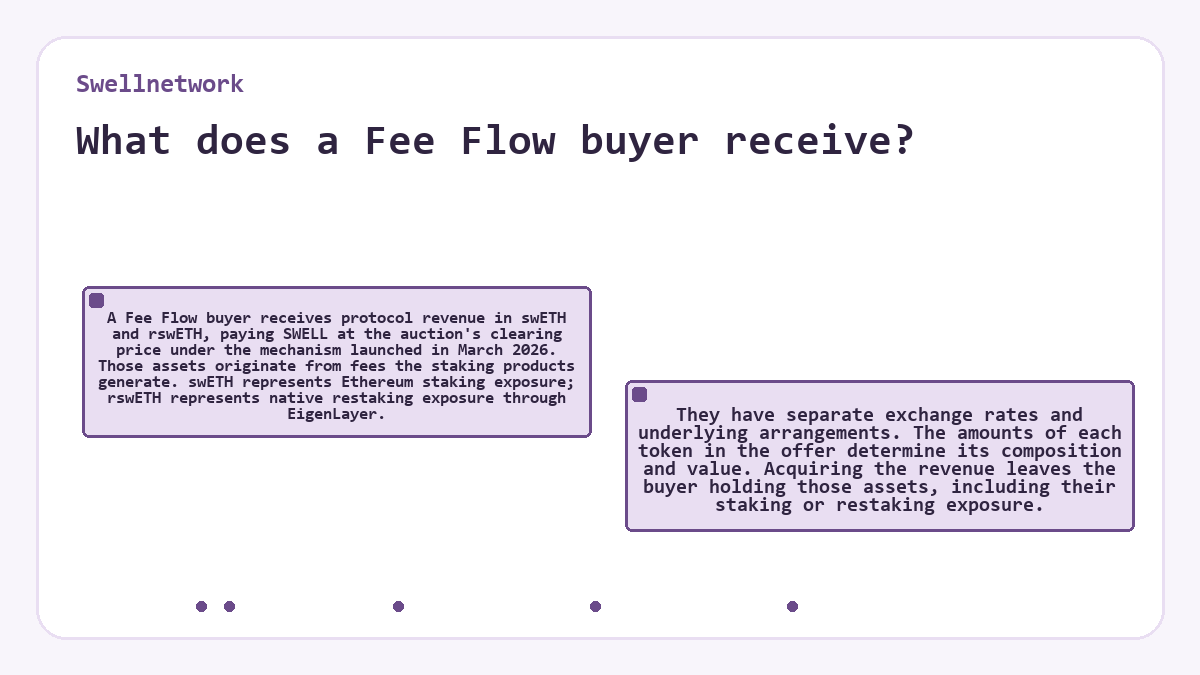
What does a Fee Flow buyer receive?
A Fee Flow buyer receives protocol revenue in swETH and rswETH, paying SWELL at the auction's clearing price under the mechanism launched in March 2026. Those assets originate from fees the staking products generate. swETH represents Ethereum staking exposure; rswETH represents native restaking exposure through EigenLayer. They have separate exchange rates and underlying arrangements. The amounts of each token in the offer determine its composition and value. Acquiring the revenue leaves the buyer holding those assets, including their staking or restaking exposure.
Comparing a SWELL quote with ETH-denominated asset values
Expressing both sides in ETH allows a comparison between the required SWELL payment and the auction assets, provided each conversion uses a clearly identified valuation basis. Multiply the total SWELL payment by its ETH market price to value the cost. Value swETH and rswETH separately, then add their ETH-equivalent amounts. Protocol exchange rates describe underlying ETH per token, while executable market quotes describe what a sale could realize. These bases can diverge. Combining a redemption-based asset value with a market-based payment cost creates a reference comparison, not an immediate resale-profit calculation.
In a hypothetical comparison, an auction offer contains 1.73 swETH and 0.83 rswETH. Its total asking price is 18,243 SWELL. Assume backing valuations of 1.083 ETH per swETH and 1.073 ETH per rswETH. Also assume SWELL trades at 0.00013 ETH per token. Every amount and rate in this comparison is illustrative.
The swETH portion has a reference value of 1.73 × 1.083 = 1.87359 ETH. The rswETH portion contributes 0.83 × 1.073 = 0.89059 ETH. Together, the offer has a reference value of 2.76418 ETH. The SWELL payment costs 18,243 × 0.00013 = 2.37159 ETH. Subtracting that payment value leaves a gross difference of 0.39259 ETH, before transaction costs or valuation changes.
That difference answers the price-comparison question only under the stated assumptions. If the same offer's SWELL asking price falls to 17,923 tokens, its ETH cost becomes 2.32999 ETH. With asset quantities and valuation rates unchanged, the gross difference increases to 0.43419 ETH. A higher ETH price for SWELL would move payment cost in the opposite direction.
A reference value for backing ETH does not establish the proceeds from selling the acquired tokens. Secondary-market prices, available liquidity, and transaction costs affect an executable outcome. If the comparison uses protocol exchange rates, accessing that ETH also follows the applicable withdrawal process.
Does burning auction payments give SWELL holders revenue?
Burning auction payments reduces SWELL supply; holding SWELL alone does not assign a holder the revenue assets a Fee Flow buyer acquires. The buyer pays for those assets, and the protocol burns the payment.
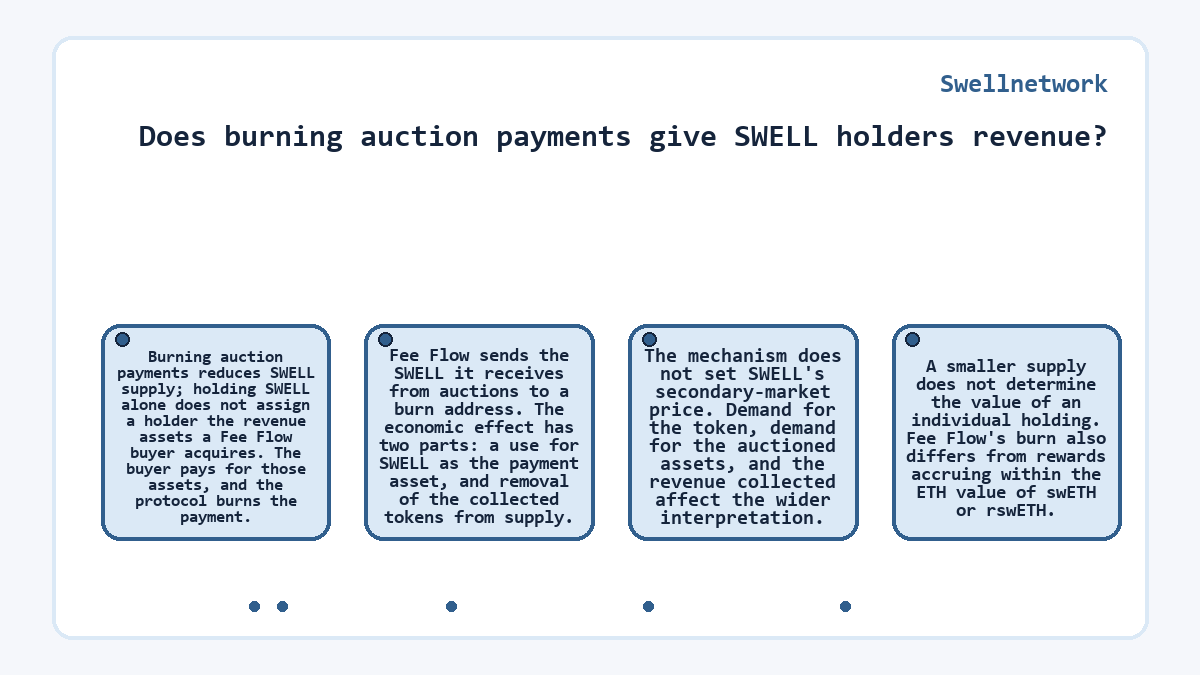
Fee Flow sends the SWELL it receives from auctions to a burn address. The economic effect has two parts: a use for SWELL as the payment asset, and removal of the collected tokens from supply. The mechanism does not set SWELL's secondary-market price. Demand for the token, demand for the auctioned assets, and the revenue collected affect the wider interpretation. A smaller supply does not determine the value of an individual holding. Fee Flow's burn also differs from rewards accruing within the ETH value of swETH or rswETH.
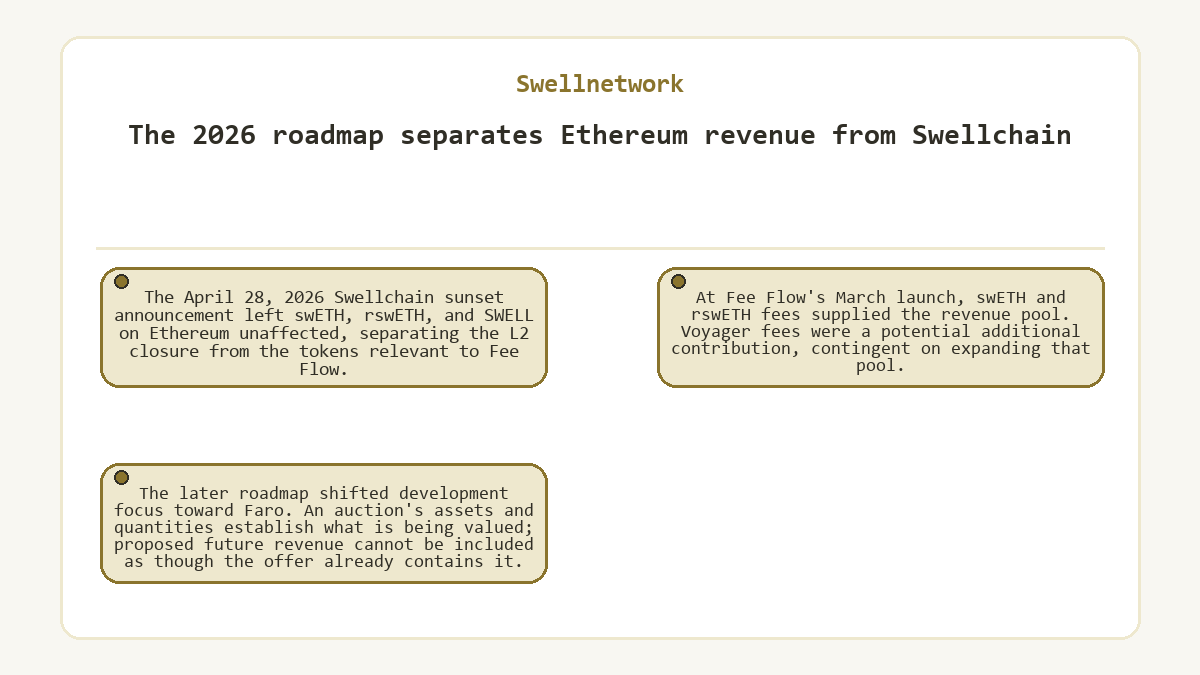
The 2026 roadmap separates Ethereum revenue from Swellchain
The April 28, 2026 Swellchain sunset announcement left swETH, rswETH, and SWELL on Ethereum unaffected, separating the L2 closure from the tokens relevant to Fee Flow. At Fee Flow's March launch, swETH and rswETH fees supplied the revenue pool. Voyager fees were a potential additional contribution, contingent on expanding that pool. The later roadmap shifted development focus toward Faro. An auction's assets and quantities establish what is being valued; proposed future revenue cannot be included as though the offer already contains it.
A falling quote versus buying the tokens on a market
A lower asking price improves the comparison only if the value of the required payment falls relative to the offered assets. SWELL's ETH market price can rise while its quoted token amount falls. Asset valuations can also move during the auction. The relationship is payment value divided by asset value, using consistent units and comparable valuation times. A smaller ratio means a lower relative purchase cost on that chosen basis. It does not remove the exposure the buyer acquires through swETH and rswETH.
Buying swETH or rswETH on a secondary market provides another way to obtain those token exposures. That route has its own executable price and liquidity conditions. Fee Flow concerns the revenue available in an auction and prices it in SWELL. A secondary-market purchase can target a particular token amount available from the chosen market. A market quote for the same token amounts offers a more direct comparison than the SWELL amount alone.
Swellnetwork: reader questions
Who may buy revenue through a Fee Flow auction?
Anyone, including arbitrageurs, can buy the offered protocol revenue through Fee Flow using SWELL at the clearing price.
How does an auction price differ from a staking fee?
The auction price is the SWELL amount paid for accumulated revenue after the staking products have generated fees. A fee charged within a staking product and the SWELL payment for collected revenue are separate amounts. An auction quote therefore does not identify the percentage charged on staking rewards.
Which protocol influenced Swell's Fee Flow design?
Euler's fee flow model influenced Swell's auction mechanism. Swell adapted that approach to its own ecosystem and token structure, using SWELL to purchase revenue generated in swETH and rswETH.
Do Fee Flow purchases work like depositing ETH to mint a liquid token?
A Fee Flow purchase exchanges SWELL for collected protocol revenue in swETH and rswETH. ETH deposits into the staking or restaking products acquire the corresponding liquid tokens through a different operation.
Does the auction schedule determine the yield on purchased tokens?
The auction schedule concerns revenue sales, while the acquired tokens retain their underlying staking or restaking exposure. The March 2026 schedule's 14-day interval cannot establish their yield. The purchase price affects acquisition cost, and the reward mechanism governs changes in the token's ETH value.
Can the SWELL burn amount be calculated from swETH revenue alone?
The burn amount follows the SWELL the auction actually receives. swETH revenue alone cannot identify it because the payment uses a different token and the clearing price matters. Any rswETH revenue included in the offer also belongs in an assessment of the assets sold.
Updated on