 Swellnetwork
 liquid staking and restaking on Ethereum
Swellnetwork provides liquid staking and restaking on Ethereum through swETH and rswETH, tokens representing ETH committed to different staking arrangements. swETH carries Ethereum staking exposure; rswETH adds an EigenLayer restaking relationship. The announced Swellchain sunset concerned the L2 and left these Ethereum products unaffected. The project also shifted its development focus toward Faro, a research-to-trade platform for Hyperliquid. Choosing among these components starts with the token, its backing, and the network where assets reside.
swETH and rswETH represent different ETH commitments
swETH represents ETH committed to Ethereum staking, while rswETH represents ETH committed to native restaking through EigenLayer.
Liquid staking with swETH
swETH is Swell's liquid staking token (LST), issued against ETH committed to Ethereum validators. It gives a holder tokenized staking exposure without requiring them to operate a validator. The token represents the deposited ETH and accrued staking rewards. Holding it maintains that economic exposure, and compatible DeFi contracts can use it for additional strategies. The backing ETH continues participating in staking. Selling swETH, requesting protocol redemption, and depositing it into another protocol affect different parts of the holding and introduce different costs.
Native restaking with rswETH
rswETH is Swell's ERC-20 liquid restaking token (LRT), representing yield-bearing ETH in its native restaking pool. Its validators use withdrawal credentials pointing to EigenLayer EigenPod addresses, connecting the backing ETH to EigenLayer's restaking mechanism. The holder keeps a transferable token while the backing ETH carries the staking and restaking commitments. Through EigenLayer, the backing ETH can help secure Actively Validated Services, systems requiring distributed validation. These commitments add risks beyond Ethereum validator exposure.
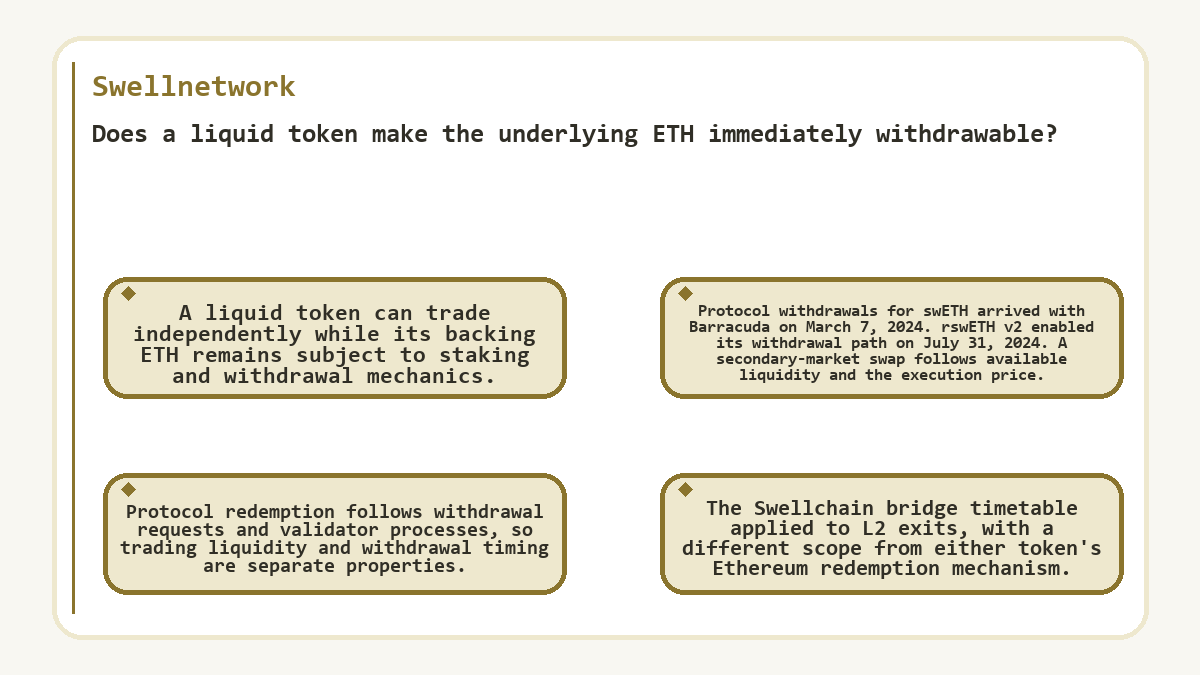
Does a liquid token make the underlying ETH immediately withdrawable?
A liquid token can trade independently while its backing ETH remains subject to staking and withdrawal mechanics. Protocol withdrawals for swETH arrived with Barracuda on March 7, 2024. rswETH v2 enabled its withdrawal path on July 31, 2024. A secondary-market swap follows available liquidity and the execution price. Protocol redemption follows withdrawal requests and validator processes, so trading liquidity and withdrawal timing are separate properties. The Swellchain bridge timetable applied to L2 exits, with a different scope from either token's Ethereum redemption mechanism.
Rewards change ETH value per token
swETH incorporates staking rewards through its ETH exchange rate without increasing a holder's token balance. rswETH also uses a repricing design. Token quantity therefore differs from ETH value, and an unchanged wallet balance can coexist with accumulated rewards. A market sale introduces another price: what a counterparty or liquidity pool will pay. Available liquidity and trade size can produce an execution price different from the protocol's accounting value. Accrued rewards do not establish the proceeds of a particular market sale.
DeFi integrations add separate exposures
Deploying swETH or rswETH into another protocol adds that protocol's contracts and strategy alongside the underlying staking exposure.
Restaking an existing swETH position
The ecosystem includes routes for restaking swETH on EigenLayer and Symbiotic. These routes use an existing liquid staking token to make an additional restaking commitment. Native rswETH exposure comes from a separate restaking pool, so the approaches have different token and contract relationships. The integration determines the supported deposit and resulting position. Withdrawal conditions belong to the chosen route. An LST deposited into a restaking protocol and an LRT held in a wallet consequently need separate treatment when considering access to the underlying ETH.
Rewards also have different origins. Ethereum staking rewards come from validator participation, while a restaking arrangement can attach additional rewards to its commitments. Promotional points and airdrop eligibility follow the rules of their individual programs. Holding a reward-bearing token does not establish a fixed allocation under a separate incentive campaign.
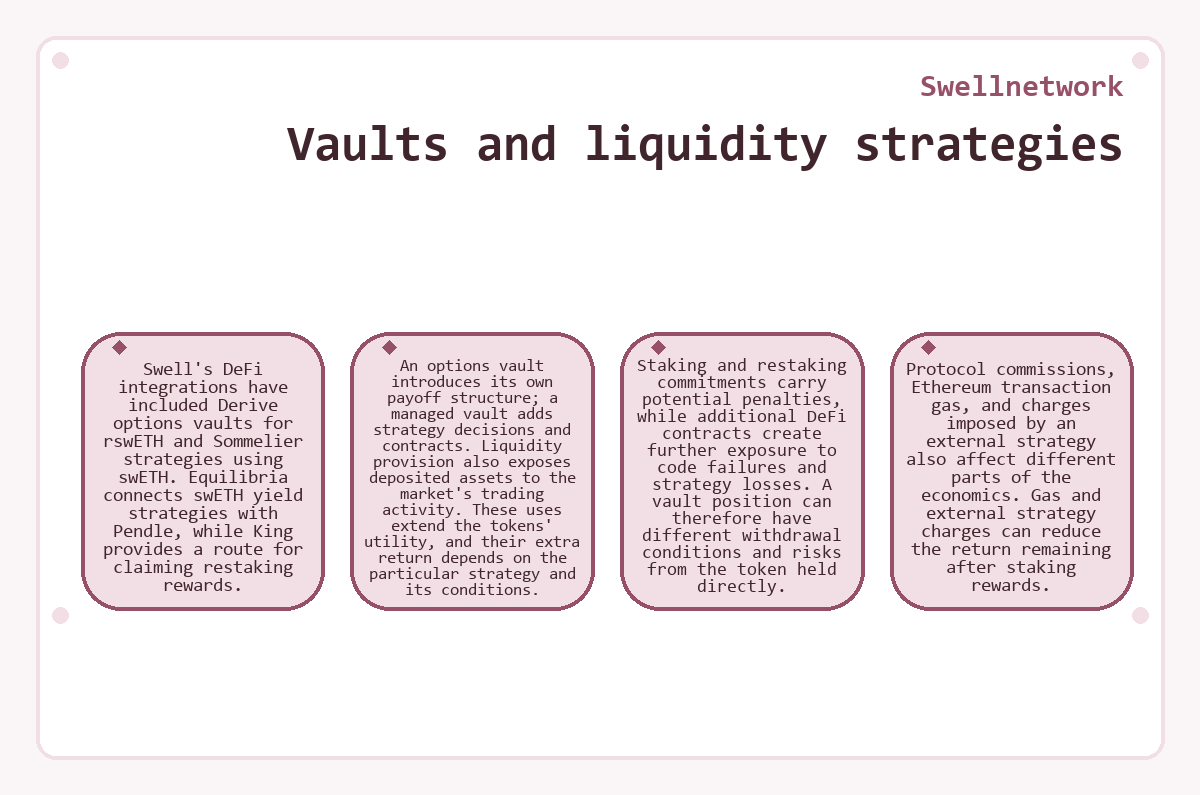
Vaults and liquidity strategies
Swell's DeFi integrations have included Derive options vaults for rswETH and Sommelier strategies using swETH. Equilibria connects swETH yield strategies with Pendle, while King provides a route for claiming restaking rewards. An options vault introduces its own payoff structure; a managed vault adds strategy decisions and contracts. Liquidity provision also exposes deposited assets to the market's trading activity. These uses extend the tokens' utility, and their extra return depends on the particular strategy and its conditions.
Staking and restaking commitments carry potential penalties, while additional DeFi contracts create further exposure to code failures and strategy losses. A vault position can therefore have different withdrawal conditions and risks from the token held directly. Protocol commissions, Ethereum transaction gas, and charges imposed by an external strategy also affect different parts of the economics. Gas and external strategy charges can reduce the return remaining after staking rewards.
Swellchain deadlines applied to the L2
Swellchain was Swell's Optimism Superchain L2, and its sunset plan applied to assets and DeFi positions on that network.
The L2 exit timetable
The April 28, 2026 plan set May 5 for disabling deposits from Ethereum. The frontend withdrawal deadline required initiation before June 15, 2026. The plan allowed chain operation until June 30, with a temporary direct-contract withdrawal route after frontend support ended. That technical route required expertise and was discouraged. Withdrawals initiated before June 15 could still finalize on Ethereum, subject to the seven-day proof window. All those announced dates have passed, and recovery of funds left on the L2 may not be possible.
A mainnet token and an L2 position
In this hypothetical example, a reader held swETH on Ethereum and a separate DeFi position on Swellchain when the sunset was announced. The mainnet token represented Ethereum staking exposure. The other position depended on Swellchain and faced its exit deadline, even if its underlying asset also appeared elsewhere in the ecosystem.
Under the sunset plan, the L2 position needed unwinding before a bridge withdrawal to Ethereum within the exit window. The mainnet swETH holding kept its staking role, so only the Swellchain portion of this wallet required the L2 exit process.
SWELL and Faro have roles beyond staking receipts
SWELL is the Ethereum ERC-20 token used to purchase protocol revenue through Fee Flow auctions.
Launched on March 6, 2026, Fee Flow auctions revenue collected in swETH and rswETH. A Dutch auction lowers its asking price until a buyer clears the offered revenue. The buyer pays SWELL and receives the auctioned revenue assets. SWELL paid to purchase auctioned protocol fees is sent to a burn address. Burning the payment reduces supply, without guaranteeing a market-price increase or a payout to every holder.
Faro is a research-to-trade platform for Hyperliquid, bringing market data and actionable insights together. In April 2026, Swell was designing a SWELL-linked Faro status program for holders and active users. That initiative had a separate purpose from Ethereum staking rewards.
Swellnetwork: quick answers
-
Will buying swETH on a secondary market still give me staking exposure?
- Buying swETH on a supported secondary market gives exposure to the same reward-bearing token. Its staking rewards accrue through the ETH exchange rate, whether the token came from a staking deposit or another holder. The purchase price and any trading costs affect what the buyer pays for that exposure.
-
Does receiving an unstake NFT mean my rswETH withdrawal has finished?
- An unstake NFT records a withdrawal request; it does not represent ETH already received. In the rswETH v2 withdrawal design, the request becomes claimable once its withdrawal conditions are satisfied. The user must then claim the ETH. Validator exit and sweep processes, restaking withdrawal requirements, and demand can affect readiness.
-
Why did older rswETH descriptions say protocol withdrawals were unavailable?
- Those descriptions reflected rswETH v1, whose January 29, 2024 launch preceded protocol withdrawals. The July 31, 2024 rswETH v2 rollout enabled withdrawal of ETH at the primary-market rate. The absence of a protocol withdrawal path in the initial version was a release-specific limitation, distinct from selling the token on a secondary market.
-
Was rswETH's zero-fee launch offer permanent?
- The zero-fee period at rswETH's January 29, 2024 launch lasted 30 days. It was a launch promotion covering protocol fees. It did not eliminate Ethereum transaction gas or establish the charges an external DeFi strategy might impose. That historical offer does not describe today's complete cost of holding or using rswETH.
-
Who reviewed rswETH v2 withdrawal code before its release?
- Sigma Prime and Nethermind audited the withdrawal code before the July 31, 2024 rswETH v2 release. The audits concerned that code, so their scope does not automatically cover later upgrades or external DeFi strategies using rswETH.
Updated on