 Swellnetwork
 withdrawals redeem swETH and rswETH for ETH through different unstaking queues
Swellnetwork withdrawals redeem swETH or rswETH for ETH at the primary market rate after the relevant unstaking process. swETH timing follows Ethereum validator exits and sweep state; rswETH also has EigenLayer restaking conditions. A withdrawal request creates an NFT, and receiving ETH requires the later claim. The 2024 launch estimates and post-slashing rswETH withdrawal guidance do not set fixed completion deadlines. Swellchain's separate bridge withdrawal window belonged to its 2026 shutdown plan.
Waiting times change with validator conditions and buffer capacity
Published waiting ranges vary with validator conditions and withdrawal demand, including whether the buffer described for rswETH can cover a request. An exit queue governs when validators leave staking. Sweep state can add another wait while Ethereum processes validator withdrawals. A holder's token balance does not show how far the underlying exit has progressed.
For swETH, the March 2024 Barracuda upgrade described a usual wait of one to seven days. It allowed for 12 days or more, depending on withdrawal amounts and requests being processed. That wider range matters when a spending deadline leaves little room for delay. Those timings concern the Barracuda release and do not establish a fixed upper bound for every later request.
The rswETH buffer can fund withdrawals without validator exits. The rswETH withdrawal documentation specifies a 14-day EigenLayer native restaking delay following the launch of slashing. It describes total waits of up to 28 days, with occasional longer delays. The July 2024 rswETH v2 rollout specified a seven-day EigenLayer native restaking withdrawal delay. Its validator sweep and exit-queue conditions add separate timing considerations. The restaking delay alone does not determine when a particular NFT-backed withdrawal becomes ready.
The rswETH buffer's July 2024 estimate was roughly one day for withdrawals it could cover. High demand could exhaust it. Validator and restaking conditions remain relevant when available capacity cannot cover a request.
Before committing tokens to redemption, compare the need for immediate ETH with the uncertainty of the queue. A market sale remains a separate exit for tokens available to trade.
Prepare the holding and the ETH needed for gas
A mainnet redemption starts with swETH or rswETH available to the withdrawing wallet and ETH available for Ethereum transaction fees. The token being redeemed determines the relevant unstaking flow. Holdings inside a DeFi contract can carry that contract's own withdrawal requirements. Identify whether the available asset is the liquid token itself or a position representing it. A Swellchain balance is another case altogether, because the historical L2 exit required bridging assets to Ethereum.
Keep enough ETH available for the transactions the wallet proposes during withdrawal. The token's ETH-denominated accounting value is not a spendable gas balance. Review the asset, amount, and network in the transaction request before submitting it. Do not treat a transaction involving a staking token as an ETH transfer merely because the interface displays an ETH equivalent.
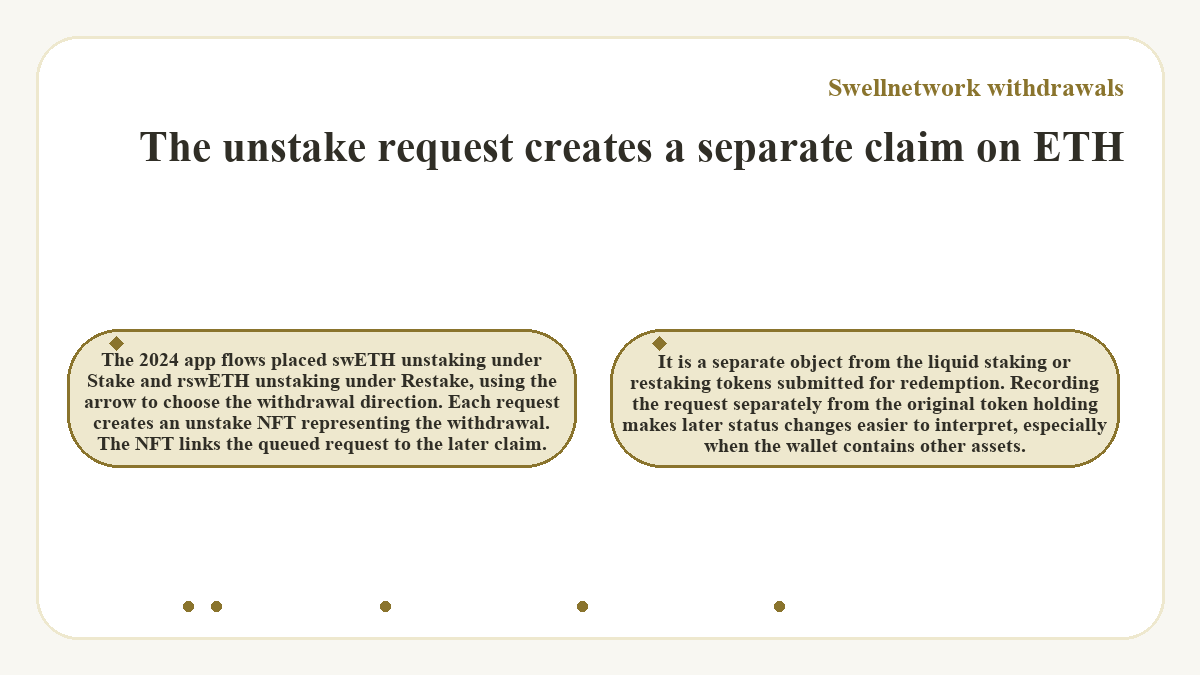
The unstake request creates a separate claim on ETH
The 2024 app flows placed swETH unstaking under Stake and rswETH unstaking under Restake, using the arrow to choose the withdrawal direction. Each request creates an unstake NFT representing the withdrawal. The NFT links the queued request to the later claim. It is a separate object from the liquid staking or restaking tokens submitted for redemption. Recording the request separately from the original token holding makes later status changes easier to interpret, especially when the wallet contains other assets.
Barracuda limits apply to each swETH withdrawal
Barracuda's March 2024 rules set a minimum withdrawal size of 0.005 ETH, measured in ETH rather than a matching count of swETH tokens. The March 2024 Barracuda rules capped each swETH withdrawal at 500 ETH. The number of withdrawals was uncapped. The ceiling therefore concerned each request, while larger total amounts could require multiple requests. Their combined timing still depended on the unstaking conditions; dividing an amount did not remove those dependencies.
The ETH value of a swETH holding depends on its exchange rate. Rewards change the value represented by each token. Apply a withdrawal limit to the denomination it specifies.
Those request sizes apply to the March 2024 swETH flow. Different token flows or changed withdrawal settings require a fresh amount check before submission.
How can an rswETH claim be distinguished from a pending withdrawal?
A pending rswETH request records an unfinished withdrawal; completion requires ETH to reach the receiving wallet through a successful claim. The app's Pending and Claimable states describe different points in that process. Neither a waiting estimate nor the mere presence of the withdrawal NFT proves the ETH has arrived.
In this hypothetical example, a reader requests an rswETH withdrawal before a personal spending deadline. The request appears as Pending, and an unstake NFT represents it. The receiving wallet still needs the eventual ETH payment, so the request record and the liquid balance describe different parts of the position.
If the request remains Pending as the deadline approaches, the reader retains the request and rechecks its readiness. The personal deadline does not change the request's readiness. Selling other rswETH still available to trade is a separate market decision; it does not demonstrate completion of this queued withdrawal. The backing ETH remains subject to its withdrawal conditions.
Once the example's request becomes Claimable, the reader claims the ETH. The claim transaction and the resulting ETH credit in the receiving wallet provide the concrete result. A balance difference alone can be obscured by gas spending or unrelated transfers, so it should be read alongside the claim transaction. An ETH payment associated with the claim establishes receipt even if the queue took longer than expected.
Swellnetwork withdrawals for stakers: Queue delays
- The unstake request creates a separate claim on ETH
- Barracuda limits apply to each swETH withdrawal
- How can an rswETH claim be distinguished from a pending withdrawal?
- A market sale depends on liquidity and execution price
A market sale depends on liquidity and execution price
A secondary-market sale can exchange swETH or rswETH for ETH without waiting for the backing validators to exit, provided a suitable market has liquidity. The available quote may differ from the primary redemption value, and large sales can incur slippage. Speed therefore comes with a different constraint: the ETH received depends on market execution.
Only tokens available to sell can take that route. An NFT-backed pending withdrawal represents a different holding, so a DEX quote for rswETH does not establish an exit for that NFT. Compare the final ETH output and transaction costs with the need for usable ETH. The market quote does not promise the same amount as primary redemption, and its usefulness changes when liquidity or the offered price changes.
Withdrawal fees and gas apply to different costs
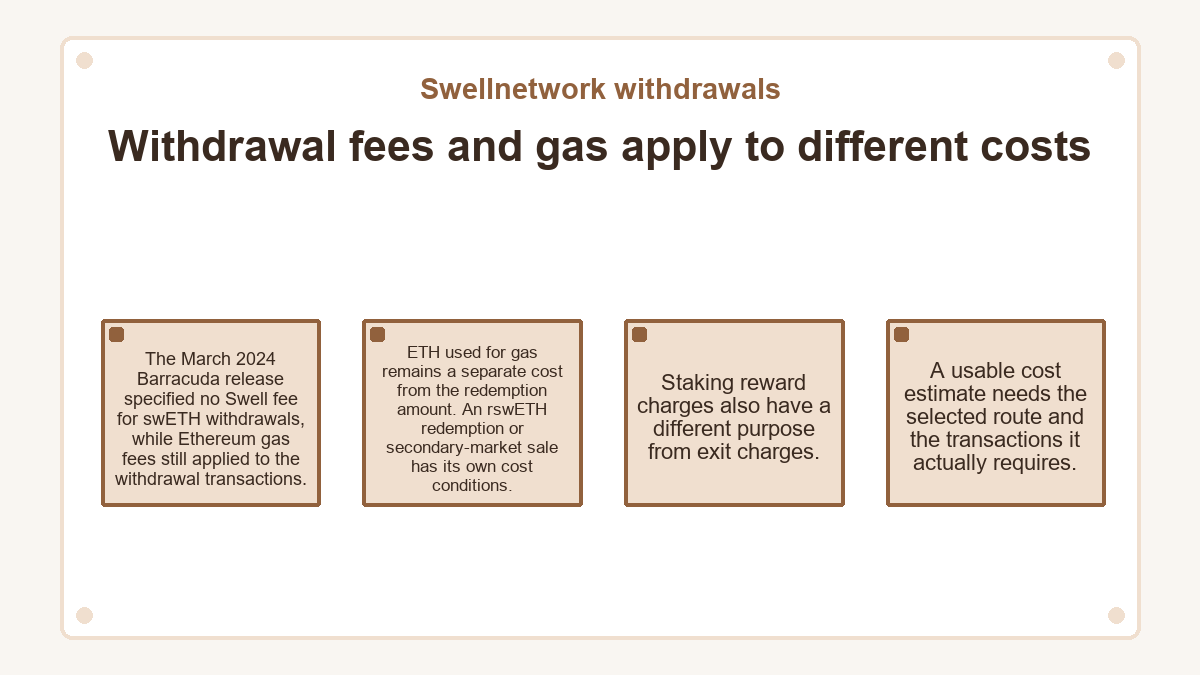
The March 2024 Barracuda release specified no Swell fee for swETH withdrawals, while Ethereum gas fees still applied to the withdrawal transactions. ETH used for gas remains a separate cost from the redemption amount. An rswETH redemption or secondary-market sale has its own cost conditions. Staking reward charges also have a different purpose from exit charges. A usable cost estimate needs the selected route and the transactions it actually requires.
Swellchain's bridge exit had a dated shutdown window
The 2026 Swellchain shutdown schedule concerned bridging assets from the L2 to Ethereum, with any L2 DeFi positions unwound before bridging. This is a separate operation from redeeming swETH or rswETH on Ethereum mainnet. The sunset announcement left those mainnet staking products unaffected. Its deadlines cannot be applied to a mainnet unstaking NFT.
The schedule called for disabling new Ethereum-to-Swellchain deposits on May 5, 2026. The Swellchain sunset plan set June 15, 2026 as the final deadline to initiate withdrawals through the frontend. Frontend withdrawal support and bridge UI support were scheduled to end after that cutoff. The chain was scheduled to keep running until June 30. The temporary direct-contract withdrawal path required technical expertise and was not recommended.
Withdrawals initiated before June 15 could still be finalized on Ethereum with the seven-day proof window. That bridge proof window and EigenLayer's native restaking delay govern separate mechanisms. All of these announced L2 dates have passed. Funds left on Swellchain after the deadline may be unrecoverable. The announced direct-contract option for initiating L2 withdrawals applied only before the scheduled June 30 shutdown.
Keep request details when investigating a delay
A delayed withdrawal needs its own request details, because token holdings, a pending NFT, and a completed ETH claim describe separate states. Keep the token type, amount submitted, wallet address, and withdrawal request record together. Retain the related transaction details as well. This helps distinguish a request still waiting on unstaking from a claim already processed for another request.
Support questions should concern the specific request and its status. General validator estimates do not explain every account's position in the process. A private key or seed phrase gives control of the wallet; neither identifies a queue position or proves a withdrawal should be ready. Do not disclose either while discussing an unstake NFT or a delayed claim.
If an ETH claim has already succeeded, its recipient and transaction details become the relevant evidence; validator waiting estimates no longer explain that completed claim.
Swellnetwork withdrawals: reader questions
Can a queued swETH withdrawal be cancelled?
A queued swETH withdrawal cannot be cancelled under the March 2024 Barracuda rules. Once it enters the queue, the ETH can only be withdrawn after the validator exit completes.
Who holds the ETH redemption right after a swEXIT NFT is transferred?
The new owner of a transferred swEXIT NFT can redeem the unstaked ETH represented by that request. Barracuda allows the NFT to be transferred or sold. Giving up ownership also removes the previous owner's ability to claim that ETH, even if they originally requested the withdrawal.
When does a swEXIT NFT get burned?
The swEXIT NFT is automatically burned when its owner claims the ETH under the Barracuda withdrawal process.
Are recent slashing events relevant to a swETH withdrawal estimate?
Recent slashing events are among the factors affecting swETH withdrawal timing under the March 2024 Barracuda rules. Request amounts, unstaking demand, and validator sweep state also influence the wait. A routine waiting range therefore cannot establish readiness for a particular withdrawal solely from elapsed time.
Does Chainlink Proof of Reserve make rswETH withdrawals instant?
Chainlink Proof of Reserve monitors the ETH backing rswETH and does not establish that a particular withdrawal is ready to claim. Readiness remains tied to the withdrawal process, including validator and restaking conditions. A reserve total and a request's Claimable state describe different facts.
Does withdrawing swETH from EigenLayer return ETH directly?
Withdrawing swETH from EigenLayer releases swETH from its separate restaking position. Redeeming that swETH through Swell is another operation involving the ETH backing the token. The intermediate swETH remains a liquid staking token; an EigenLayer exit alone does not complete its redemption for ETH.
Updated on